Cities > Rome > 7 Things Tourists Don't Do in Rome, but You Should...
6) Have a Curry by the Aqueduct
The ethnic enclave of Torpignattara and the Acquedotto Alessandrino
Torpignattara — often spelled as two words, Tor Pignattara, and sometimes abbreviated as Torpigna — can trace its origins as a village back to 400 AD. It began its path to urbanization when it was linked to the core of Rome via the Rome-Fiuggi railway in 1917. Now referred to as the Roma-Giardinetti railway or the Laziali tramway, it has seen better days. Largely blown up in WWII and partially rebuilt and partially decommissioned over the decades, it was expected to be discontinued entirely in 2016. However, the rail line was saved at the last minute by a decision to modernize the route rather than discontinue it. Many non-air conditioned and rattly old train cars still are in active use, which is less than ideal for commuters, but for a visitor to Rome, getting to Torpignattara on such a vintage train is half the fun.
Like Pigneto — not far to the north — Torpignattara was hit hard by WWII and subsequent deindustralization, but perhaps because of its modestly more distant location, locals deserted the neighborhood in larger numbers. As working people bailed, they left behind vacant buildings, a population too small to support retail, and increasing crime and drug problems. In the 1980s and 1990s, these cheap unoccupied buildings became attractive to new immigrants, particularly from India, Bangladesh, China, and Egypt. The neighborhood now is around 20% foreign born — and no doubt feels much less Italian than it once did — but its occupancy rates and financial situation both are improving. Hard-working immigrants generate more economic activity than empty buildings.
Today, Torpignattara is considered a high crime area. Still, it is worth noting that the perception of crime is much higher than actual crime and the highest crime rate in Rome is in and immediately around Termini station where it is far too common for tourists to be scammed, pickpocketed, or robbed.
Now is a good time to remind you that travelgasm.com, and the author thereof, are not legally responsible for you in any way in Torpignattara or anywhere else — and you always should be vigilant about your safety and not wear or carry expensive items — but if you visit Torpignattara in the morning, stick to the high street and don't go looking for trouble, you are unlikely to find it. Statistically, dragging your luggage through Termini is likely to be much higher risk than going to Torpignattara.
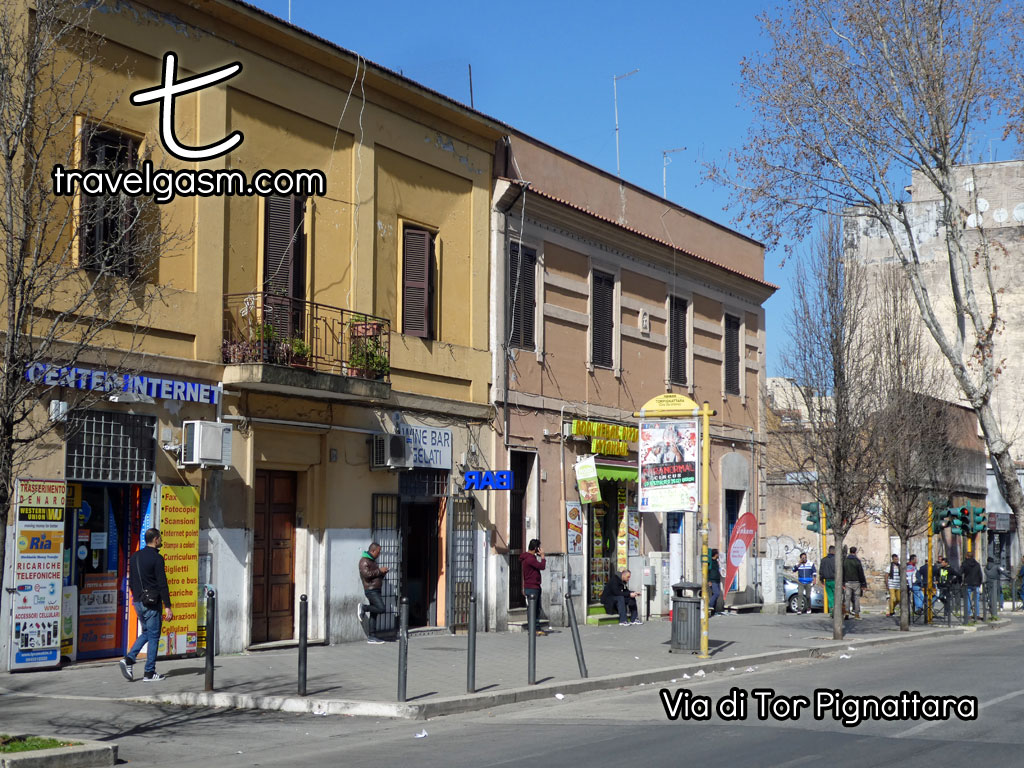
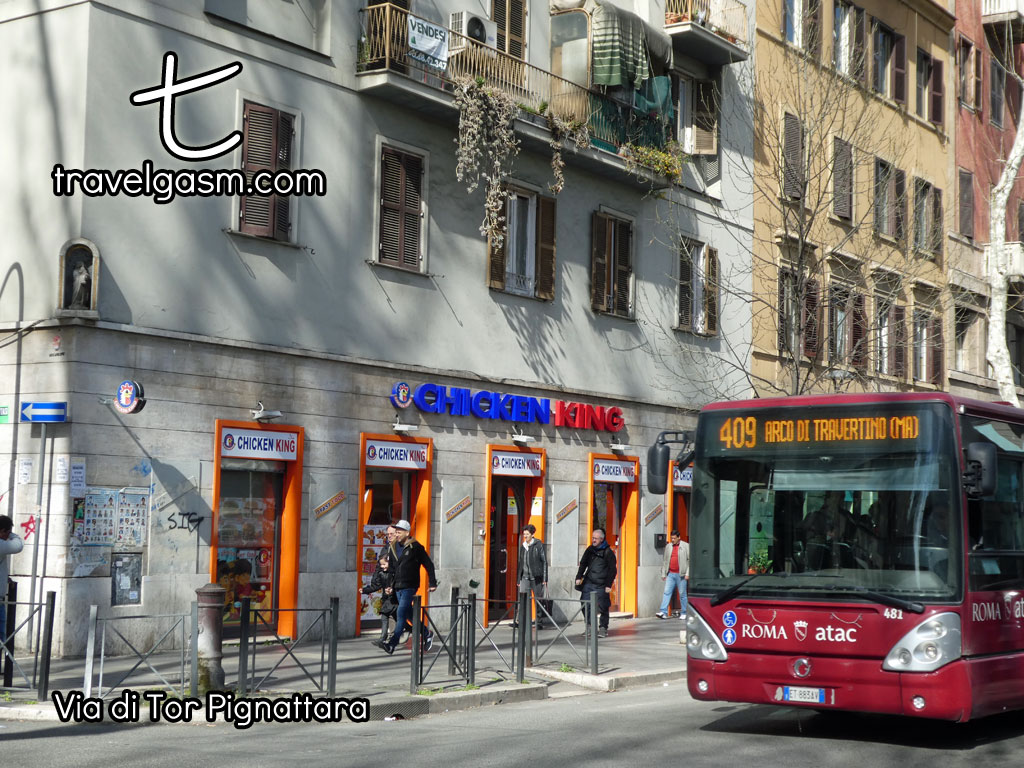
Via di Tor Pignattara
The high street just to the south of Tor Pignattara station is the appropriately named Via di Tor Pignattara. Tree-lined and relatively small scale, it is a pleasant stroll with retail targeted both to local Italians and the immigrant communities. Currently, there is little gentrification in Torpignattara. It is just a genuine neighborhood where people live. Apart from murals here-and-there, little, if anything, formally is of interest to tourists.
Torpignattara is an excellent neighborhood for an inexpensive Indian, Arabic, or Chinese meal, though. Among the many restaurants to choose from, one we enjoyed was Spice of India. If you would prefer to stick with Italian food, plenty of Italian options like the historic Caffe Valentini dal 1959 for a coffee or simple breakfast or Il Pomo D'oro for a cheap all you can eat pizza lunch are available. All three of these joints are on the high street.
The Alexandrina Aqueduct
Lest you forget you are in Rome, toward the end of Via di Tor Pignattara is a modest park — Parco Giordano Sangalli — with a pleasant view of a segment of Acquedotto Alessandrino (Aqua Alexandrina). Built in 226 AD, it is the last of 11 ancient Roman aqueducts. You can see some of this aqueduct on the train ride to Torpignattara when it passes through Porta Maggiore (Larger Gate), but this park hosts a more substantial section.
The park could be more attractive — largely because maintenance and trash collection could be better, but trash collection can be a problem throughout Rome. Watch your step. It is rather surreal to see what once was a marvel of engineering but now is a largely ignored backdrop to a dog park in an underappreciated corner of the city.
You may find yourself thinking about just how much human civilization has changed since this aqueduct was constructed and wonder what structures we find amazing now might be abandoned and ignored in the future. Discuss it over a curry or a cheap pizza before heading back on the train to Termini.
We've mapped out the quick route to Via di Tor Pignattara and Aqua Alexandrina below.
How to Get Here: From Termini Station, walk through the station on the first floor toward the southeast to the Termini-Laziali station next door. Termini-Laziali is the terminus for the Rome-Giardinetti railway, but it is operated by the same company and uses the same stored value card as the Rome Metro. Take the train to Tor Pignattara. The suggested walk starts toward the south (to the right of the train if you are arriving from Termini-Laziali).
Cities > Rome > Rome Overlooked 7 > Next: (7) Stroll the Forgotten Stars... >>
Like Torpignattara or Acquedotto Alessandrino? Tell your friends and frenemies on social media that you discovered them first:
Intelligent and good-looking readers of travelgasm.com like you also sign up for our free mailing list.
Live in Rome? What's your favorite "local" thing to do? Spotted anything out-of-date or inaccurately translated? Please tell travelgasm.com. Grazie!