Cities > Rome > 7 Things Tourists Don't Do in Rome, but You Should...
7) Stroll the Forgotten Stars
Tuscolano: The Walk of Fame & Shopping Near Subaugusta Station & Cinecitta
In the 1930s, Rome spread in all directions, but toward the southeast it grew along a tram line to the newly constructed Cinecittà (Cinema City). Cinecittà was — and still is — the largest film studio in Europe. Other commercial and residential areas grew in tandem along the tram line, as well.
Unfortunately, in 1958, Rome built a freeway — then Circonvallazione Subaugusta, now Viale Palmiro Togliatti — that physically severed much of the neighborhood from Cinecittà. When combined with brutal underfunding of the tram line, these actions significantly damaged the area. However, unlike many other parts of the city, residents managed to keep the tram limping along in service until 1980 when it was replaced by a metro line that had been planned since 1962.
With its roots in the tram system, the structure of much of this portion of Rome remains dense and walkable, although the walkable neighborhood and Cinecittà still are two different destinations for all practical purposes. Despite their relative proximity to one another, these areas are united by theme but not by foot.
Cinecittà Studios
Founded in 1937 by Benito Mussolini and associates with the now famous slogan Il cinema è l’arma più forte or "Cinema is the most powerful weapon," Cinecittà Studios first was opened to the public in 2011. Although its glory days were in the 1950s and 1960s when it churned out now classic films like the Italian La Dolce Vita and Hollywood productions like the original Ben Hur, it still is very much an active studio.
It should be emphasized that Cinecittà Studios is not an amusement park. In 2014, Cinecittà did open an amusement park to the south of Rome called Cinecitta World, and it is clear that some tourists go to Cinecittà Studios expecting to find rides and games and are disappointed. If you want an amusement park vaguely themed around the film industry, go to Cinecittà World. If you want an excellent museum about the history of Italian cinema that also throws in a modest tour of a couple of actual film sets, head to Cinecittà Studios. Note that Cinecittà Studios is closed on Tuesdays and stops selling tickets at 4:30 PM.
Cinecittà Studios is intended to be a tourist destination these days, but it barely surpasses the top 400 attractions on the big tourist advisory sites, so travelgasm.com could consider even it to be a good selection for our 7 Things Tourists Don't Do in Rome, but You Should. The neighborhood next door is nowhere near the tourist trail and definitely qualifies.
The Walk of Fame & Shopping in Subaugusta
Historically, the area to the west of Cinecittà along Via Tuscolana simply was called Tuscolano, and many still refer to the whole area by that name. Technically, Tuscolano now is a smaller area further west, and the area closer to Cinecittà is split between the Don Bosco and Appio Claudio quarters. Because we are most interested in the area between Subaugusta station and Giulio Agricola station — with Subaugusta as the starting point — we will refer to this area as Subaugusta for convenience.
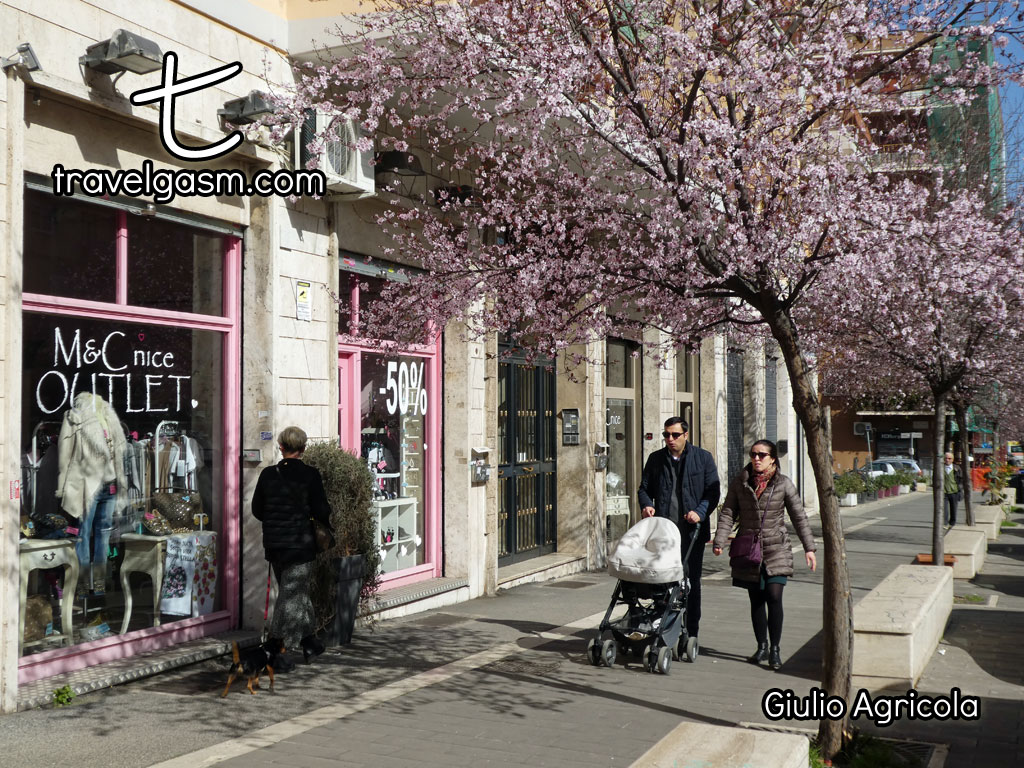
Via Tuscolana is not a pretty street; it is quite wide, and the space once occupied by the tram now is a particularly ugly car park. The street is flanked by modest highrise apartment blocks, but they nearly all have ground floor retail, and the area is quite walkable for suburban Rome.
On the south side of the street starting from Subaugusta and going toward Giulio Agricola there also is an underappreciated Hollywood Boulevard-style Walk of Fame for Italian film stars, mostly from the 1960s and 1970s. Some heavily vandalized signage with explanations in Italian can be seen there, but it certainly appears to be largely ignored by tourists and locals alike. If you're interested in Italian cinema — or would like to learn more — this stroll is worthwhile by itself, but the area is even more worth the visit for the local shopping and restaurants.
Subaugusta is a young, middle-class area. The shopping is not centered around luxury brands like many portions of Centro Storico, but rather cheap local fashions that skew young and that blend Italian styles with noticeable influence from the back streets of Tokyo and Seoul. There are cheap, mainstream stores like H&M, but also fun local shops like Jessica for women and Babalus & Babalusino for women and men. It's a great place to walk around and find your own favorites.
To eat near Subaugusta, we enjoyed the local Moma Pizzeria Romana for Italian food and a branch of the international chain GROM for gelato (right next to Federico Fellini's star), but there also are dozens of other options.
We've mapped out our preferred route below on the main street, Via Tuscolana, as well as two better people-priority side streets — Largo Appio Claudio and Viale Marco Fulvio Nobiliore.
How to Get Here: For Cinecittà Studios, take Metro Line A (Orange) to Cinecittà Station. After the turnstiles, take the left exit and use the stairwell to the right to go to the front door of Cinecittà. For our suggested walk at Subaugusta, take Metro Line A (Orange) to Subaugusta Station. After the turnstiles, turn left, take the right staircase, and turn left on Via Tuscolana. For all practical purposes, it is not possible to walk between Cinecittà and Subaugusta, and for your safety, we would highly recommend using the metro between these two stations.
Cities > Rome > Rome Overlooked 7 > Next: Rome Photo Gallery... >>
Like Subaugusta or Cinecitta? Tell your friends and frenemies on social media that you discovered them first:
Intelligent and good-looking readers of travelgasm.com like you also sign up for our free mailing list.
Live in Rome? What's your favorite "local" thing to do? Spotted anything out-of-date or inaccurately translated? Please tell travelgasm.com. Grazie!